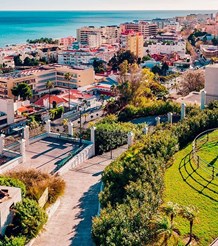
Optimism is the fuel that feed the property business, and the professionals involved in it are loathe to speak of recession. They prefer to think of it as a slight drop in temperature. But nobody denies that things are not going quite as well in recent times than they went in the past. A study into the business on the Costa del Sol, carried out by the Aguirre Newman property consultants, puts it like this: It’s not that fewer properties are being sold, but that it takes longer to sell them.
“Sales continue to grow, but the rise in prices is less spectacular and sales has slowed down,” says Emilio Langle, director of the Aguirre Newman residential section. The average apartment on the Costa del Sol sells within two years, on average, and chalets sell within an average of two and a half years. According to recent surveys, this is twice as long as three or four years ago.
The writing is on the wall, although the situation has not yet reached crisis point. “What is happening is that we are returning to a more normal situation. Apartments were being sold before, not just off-plan, but from plans that were no more than vague ideas. Now the buyers are stopping to think, and this is not a bad thing,” says Cayetano Rengel, president of the Official College of Real Estate Agents (Coapi) in Malaga.
Too much supply
Although alarm bells have not yet started ringing in the building industry, the real estate agencies, which are the final rung of the sales ladder, are beginning to feel the pinch. The sector is now suffering the consequences of the glut of offers available over the last couple of years. Following on the heels of the building boom, real estate agencies have sprung up like mushrooms. This is clearly shown by the fact that in 2004, there were about 5,200 agencies registered with the Chamber of Commerce in Malaga, against 3,800 of them in 2002. This is an increase of 38 per cent in just two years.
The icing on the cake that the estate agents take home these days is not quite as tasty as before. “In 2000, the business of real estate was liberalised, allowing anybody to set up shop. The result is that all kinds of agencies have been established since then, and the entire business suffered,” says the president of Coapi. The business is not quite so clear cut now, especially in the area of rural sales, where agency profits have fallen by 70 per cent in the last year, according to sources in the sector.
The restrictions in the planning laws, which were implemented in 2003, have had a marked effect on sales in the interior of the province. “That year was fine, but the bottom more or less fell out of the business after that, and was especially apparent in rural property sales,” says Sebastián Bernal, director of the Sebergón agency, operating in the Coín area. In a few months, the municipality saw the opening of 20 new agencies, many of which were run by foreigners who thought they were on to a good thing. Those that deal exclusively with rural properties are having a bad time, to the point that many have had to close,” says Bernal, “On the other hand, those of us who were here before the boom, and who are from the town, have managed to survive.”
According to Cayetano Rengal, this has caused much of the present problem. “Everybody was saying that real estate was an easy business to establish oneself in, and they all wanted to jump on the bandwagon. But the reality is very different, and the reality is that you have to know how to sell a property,” says the president of Coapi.
NEws provided by Antonio Campos (Sur in English)
|